Personal essays, notes, and ideas worth sharing.

Category: Default (page 19 of 21)

The Places That Fooled Me Into Feeling Home

I Used to Think Home Was Where You Grew Up

For the longest time, I had this ironclad theory about home. It was simple, clean, and completely wrong. Home was where your childhood happened, where your parents still lived, where you could navigate with your eyes closed. Done. Case closed. Thank you for coming to my TED talk.

The Places That Fooled Me Into Feeling Home

Then I spent three days in a tiny bookshop café in Prague, and my entire worldview crumbled over a mediocre cappuccino. I wasn’t even supposed to be there. My original plan was the big tourist stops, but rain had other ideas. So there I sat, watching the owner argue with her ancient espresso machine in rapid Czech, and something in my chest just settled. Like furniture finding its proper place.

The thing is, I’d never even been to Prague before. I didn’t speak the language. I knew exactly three people in the entire country, and I’d met them all at the hostel that morning. By my own definition, this place should have felt as foreign as Mars. Instead, it felt like coming home from a very long trip.
Illustration for The Places That Fooled Me Into Feeling Home

The Grocery Store That Changed Everything

Six months later, back in my actual hometown, I found myself standing in the cereal aisle of the same grocery store I’d shopped at for twenty years. The fluorescent lights hummed their familiar tune. The floor had that specific pattern of scuffs I could probably trace from memory. This should have been home base, right?

Instead, I felt like an actor who’d forgotten their lines. Everything looked right but felt slightly off, like trying to wear clothes that no longer fit quite the same way. The teenage cashier called me “sir” with the kind of politeness reserved for strangers. The produce guy, who used to ask about my mom, looked right through me.

That’s when it hit me. I’d been confusing familiarity with belonging. They’re not the same thing at all. Familiarity is knowing where they keep the good avocados. Belonging is when the place somehow knows you back.

The Science of Belonging (Or What I Learned From a Barista)

I started paying attention after that. Really paying attention. Turns out, the places that feel like home have this weird pattern. They’re not necessarily the most beautiful or the most comfortable. They’re the ones where small interactions happen naturally.

There’s this coffee shop three blocks from my current apartment. The barista remembers that I always ask for oat milk but actually prefer regular milk in my cortado. She never mentions this contradiction, just makes it right. When I travel for work and come back, she’ll say something like “the usual?” with this tiny smirk that says she knows I’ve been drinking inferior coffee for days.

That’s it. That’s the whole magic trick. Someone noticed a small thing about me and decided it was worth remembering. Not because they had to, but because that’s what people do in places where you belong. They see you as more than just another transaction in their day.

The Library That Taught Me About Timing

Here’s where I really had to eat crow on my original theory. I’ve been going to the same library branch for four years now. Same corner table, same view of the parking lot, same guy who always falls asleep reading newspapers by 2 PM. Classic case for feeling at home, right?

Except for the first three years, it was just a library. Quiet, useful, perfectly fine. Then something shifted. Maybe it was when the librarian started saving the new mystery novels for me. Maybe it was when I began nodding to the newspaper sleeper like we were old friends. Maybe it was just time.

Because that’s the other thing I got wrong. Home isn’t just about the right place. It’s about the right time in your life to recognize it. I could have sat in that Prague café five years earlier and felt nothing but caffeine jitters. Some places have to wait for us to be ready to receive them.

The timing thing explains why childhood homes can start feeling foreign. You change, but the place stays frozen. Meanwhile, new places catch you at exactly the right moment of openness, when you’re ready to be known by somewhere else.

What I Know Now (And What I’m Still Learning)

So here’s my updated theory, version 2.0. Home isn’t about geography or history. It’s about recognition. The place recognizes something in you, and you recognize something in it. Sometimes this happens immediately, sometimes it takes years, and sometimes it never happens at all despite your best efforts.

I still get it wrong plenty. I’ve convinced myself I could belong in places that were never going to want me back. I’ve walked away from places too quickly, before giving them a proper chance to know me. I’ve confused Instagram-worthy with soul-worthy more times than I’d like to admit.

But I’m getting better at reading the signs. The way a place handles your mistakes. Whether it has room for your particular brand of weirdness. How it feels on a Tuesday afternoon when nothing special is happening. These things matter more than the perfect lighting or the trendy neighborhood designation.

The biggest surprise? I can have more than one home now. That Prague bookshop still counts, even though I’ve only been back twice. My childhood bedroom counts too, but differently than it used to. The coffee shop, the library, the park bench where I figured out what I wanted to do with my life, they all count.

Turns out home was never meant to be singular anyway. We’re allowed to belong in multiple places, to different degrees, for different reasons. The heart is bigger than I gave it credit for.

I’m curious about your places. The ones that surprised you by feeling like home when they shouldn’t have, or the ones that stopped feeling like home when you expected them to last forever. What makes a place claim you? I’m still collecting data on this theory, and I suspect I always will be.
The Art of Sucking at Things (And Why I’m Getting Really Good at It)

My Current Disaster Portfolio

I’m learning watercolor painting right now, and I’m spectacularly bad at it. Not charmingly bad in that “oh, look how quirky” way that makes for good Instagram content. I mean genuinely, frustratingly terrible. My trees look like green cotton candy that got caught in a rainstorm. My skies have the consistency of chocolate milk. Last week I tried to paint a simple cup of coffee and somehow created what can only be described as a brown void with abandonment issues.

The popular narrative around learning new skills is all wrong. We’re supposed to embrace the beginner’s mind, find joy in the journey, celebrate small wins. But nobody talks about the specific agony of being conscious enough to see exactly how bad you are while being powerless to fix it. It’s like being trapped in a glass box, watching yourself fail in high definition.

Here’s what I’m discovering: being bad at something is not a phase to rush through. It’s a skill in itself. And most of us are terrible at being terrible.

The Mythology of Natural Talent

We have this weird cultural obsession with prodigies and natural talent that makes normal learning look like personal failure. Watch any movie about someone learning something new and they’re either immediately gifted or they montage their way to competence in three minutes of screen time set to uplifting music.

Real learning looks like me staring at my watercolor mess for twenty minutes, convinced I’ve somehow made it worse by adding more paint. It looks like my guitar teacher diplomatically suggesting we “revisit” the same chord progression for the fourth week in a row. It looks like my attempts at sourdough starter, which I’m pretty sure achieved sentience before dying a mysterious death in my refrigerator.

The mythology of natural talent is comforting because it lets us off the hook. If someone is just “born good” at something, then our struggles aren’t personal failings. But it’s also limiting. It suggests that if you’re not immediately good at something, you probably never will be. This is flat-out wrong. It’s backwards. The people who get really good at things are usually the ones who were willing to be really bad at them for longer than seems reasonable.

The Specific Physics of Incompetence

Being bad at something has its own peculiar physics. There’s the way your body rebels against new movements, like when I try to paint loose, flowing brushstrokes and my hand insists on creating tiny, tight scratches instead. There’s the mental lag between seeing what you want to create and discovering your skills are about three levels behind your vision.

Then there’s what I call the competence mirage. You have one good practice session, one decent painting, one chord progression that doesn’t sound like a cat in distress, and suddenly you think you’ve turned a corner. The next session brings you crashing back to reality with the gentle force of a brick wall.

But here’s the thing nobody mentions: incompetence has its own weird rewards. When you’re truly bad at something, every tiny improvement feels massive. The first time I managed to paint something that vaguely resembled the thing I was trying to paint, I felt like I’d discovered fire. When you’re operating at the bottom of the skill curve, the smallest gains feel enormous because they are enormous, proportionally speaking.

Why We Quit Too Early

Most people abandon new skills right at the point where learning gets interesting. Not in the honeymoon phase when everything is new and exciting, but in that middle stretch where you know enough to see how much you don’t know. This is where the real learning happens. It’s also deeply uncomfortable.

We quit because we’ve been taught that struggle equals wrongness. If something is hard, we must be doing it wrong or we must not be cut out for it. But struggle is just the texture of growth. It’s your brain literally rewiring itself, which apparently feels exactly like being bad at things for longer than seems fair.

I watch people in my watercolor class drop out around week six, right when the instructor starts pushing us beyond copying simple techniques. They leave just as they’re developing their own artistic problems to solve, their own questions to wrestle with. They’re quitting at the exact moment when learning transforms from following instructions to developing judgment.

The irony is that being willing to be bad at something for an extended period might be the most useful skill you can develop. It’s certainly more useful than being naturally good at any specific thing.

The Long Game of Learned Incompetence

I’m starting to think of my various failures as a kind of portfolio diversification. Each thing I’m bad at teaches me something different about the mechanics of learning itself. Watercolor is teaching me patience with unpredictable outcomes. Guitar is teaching me how to practice when progress feels invisible. Cooking is teaching me that following directions exactly still somehow leads to creative disaster.

The meta-skill I’m developing is staying curious instead of defensive when things don’t work. Instead of getting frustrated with my muddy paintings, I’m getting interested in why they’re muddy. Instead of avoiding the guitar when my fingers refuse to cooperate, I’m studying exactly where the breakdown happens.

Maybe the point isn’t to get good at watercolor or guitar or sourdough. Maybe the point is to get good at being bad at things, which turns out to be excellent preparation for being good at anything.

What are you learning badly right now? I’d love to hear about your own disasters in progress. There’s something oddly comforting about comparing notes on our various incompetencies.

The Things I Don’t Do Anymore (And Why That’s Actually Good News)

The Morning Scroll That Wasn’t Actually Morning Anymore

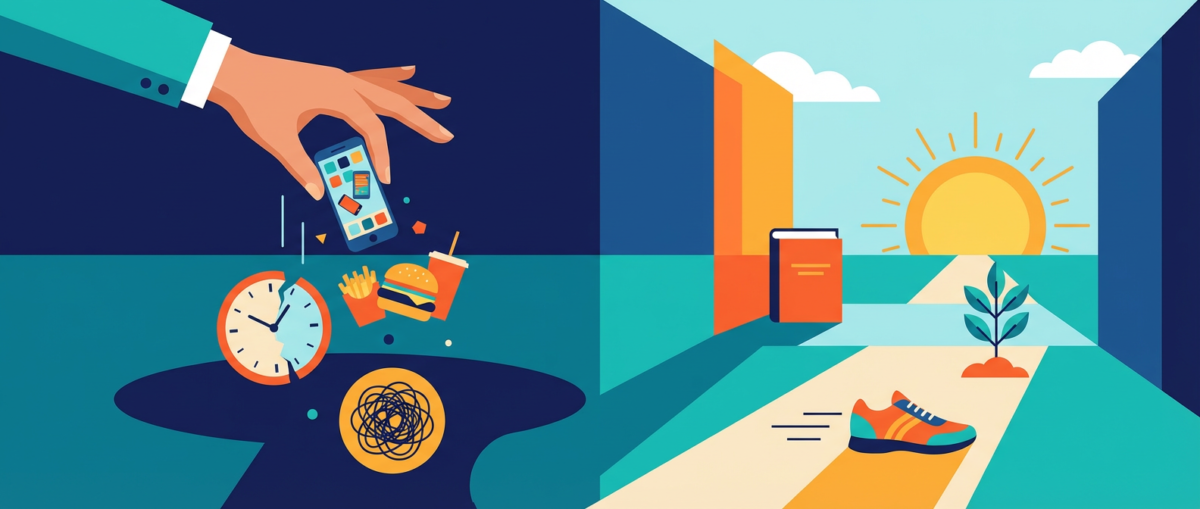
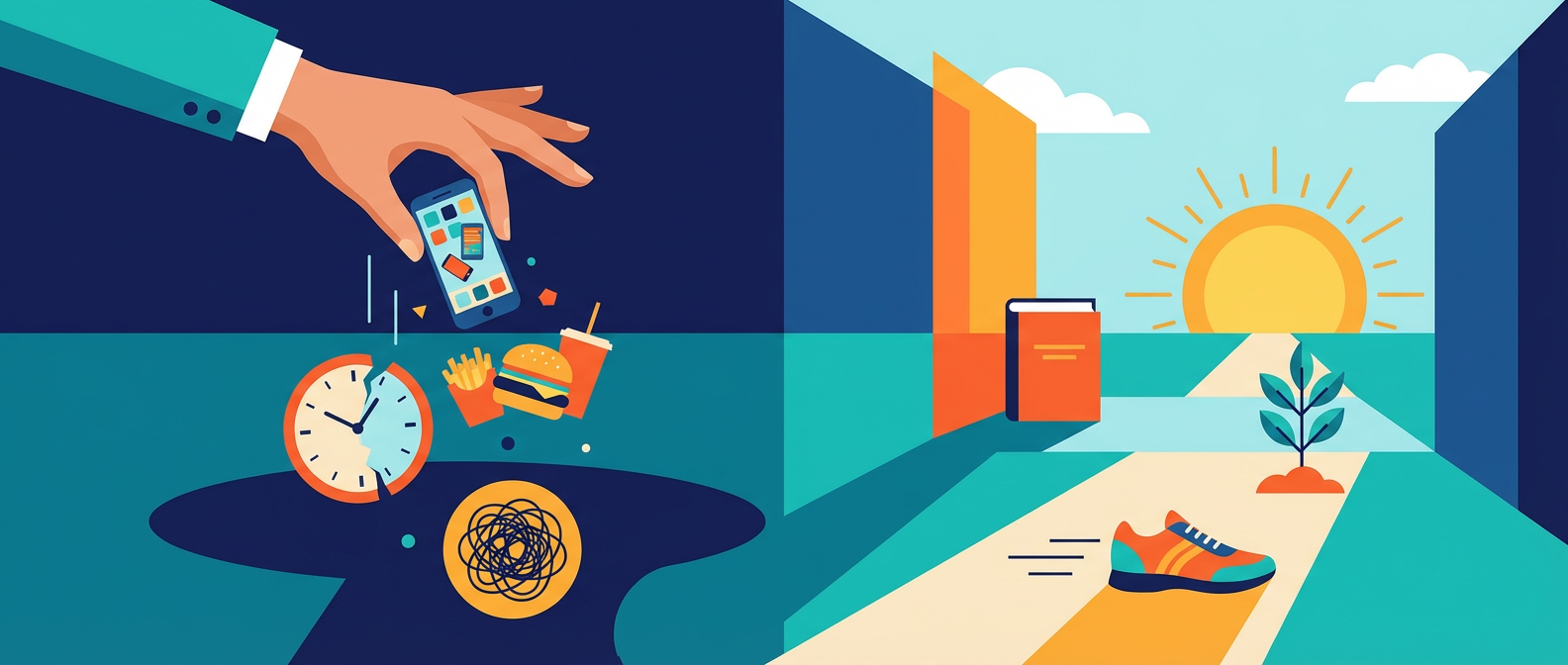
I used to check my phone before my feet hit the floor. You know the drill—that automatic reach for the nightstand, the squinting at notifications, the immediate download of everyone else’s urgency into my barely-conscious brain. I told myself it was just five minutes of catching up, but my screen time reports had other ideas. Turns out “five minutes” was doing some creative accounting.

The Things I Don't Do Anymore (And Why That's Actually Good News)
The Things I Don’t Do Anymore (And Why That’s Actually Good News)

The breaking point came during a family breakfast when my nephew asked me a question three times before I looked up from scrolling through replies to a tweet I’d forgotten I’d posted. His little face had this confused expression, like he was trying to figure out what invisible thing was more important than pancakes and his story about finding a cool rock. That hit differently than all the articles about phone addiction ever could.

Now my phone stays in another room until after coffee. Real coffee, not the distracted sipping while reading about strangers’ weekend plans. It’s been six months, and I haven’t missed a single important thing. Turns out the world doesn’t actually need my immediate awareness of every trending topic at 7 AM.

Illustration for The Things I Don't Do Anymore (And Why That's Actually Good News)
Illustration for The Things I Don’t Do Anymore (And Why That’s Actually Good News)

The Productivity Theater I’d Been Starring In

I was the person with seventeen different task management apps, color-coded calendars, and a bullet journal that looked like it belonged in a museum. I optimized everything except the actual doing part. My system for getting things done had become more complex than the things themselves.

The absurdity hit me when I spent forty-five minutes researching the best app to track my habit of researching productivity apps. I was meta-procrastinating, which feels like it should earn some kind of award for creative avoidance. My elaborate systems had become their own full-time job, complete with maintenance schedules and upgrade anxiety.

These days I keep a single notebook and write down what needs doing. Revolutionary, I know. Things still get done, maybe more efficiently because I’m not constantly managing my management system. Sometimes the old ways work precisely because they don’t try to work perfectly.

The Expert Opinions I’d Been Collecting Like Stamps

I used to treat podcasts and newsletters like homework assignments. Every productivity guru, every thought leader, every person with a framework for living better—I absorbed it all with the dedication of someone studying for a final exam in Life Optimization. My phone was basically a portable university of other people’s certainties.

The problem with consuming endless expert advice is that you start believing expertise is something you download rather than develop. I had opinions on everything and experience with nothing. I could tell you the “research shows” answer to any life question but couldn’t figure out what worked for me specifically, not people-in-general or study-participants-under-controlled-conditions.

I still learn from others, but now I’m pickier about whose voice gets real estate in my head. I’ve learned to tell the difference between information that changes how I think and information that just makes me feel informed. The difference is sharper than you’d expect once you start paying attention.

The Perfect Version of Myself I’d Been Chasing

Future Me was going to be amazing. She’d wake up at 5 AM for yoga, meal prep on Sundays, and have opinions about wine that went beyond “tastes like grapes.” She’d be the kind of person who remembered birthdays without Facebook reminders and always had the right gift wrapped beautifully with matching ribbon.

Current Me kept letting Future Me down, which created this weird resentment toward myself for not being someone I’d never actually been. I was constantly disappointed in my present self for not living up to the standards of my imaginary self. It’s like being mad at your reflection for not looking like someone else entirely.

The shift happened when I realized I was trying to optimize toward someone else’s definition of good rather than figuring out what good meant for me. Maybe I don’t want to wake up at 5 AM. Maybe meal prep makes me feel trapped rather than organized. Maybe my version of having it together looks different from the Instagram version.

The Conversations That Went Nowhere But Took Forever

I used to feel obligated to engage with every discussion, to have takes on every topic, to prove I was informed and engaged and thinking about the right things. Social media had trained me to believe that not commenting was somehow a form of negligence, like failing to vote in the democracy of opinions.

But most online discussions aren’t actually discussions, they’re performance art where everyone’s playing to different audiences. People aren’t trying to learn or change minds; they’re trying to demonstrate their existing beliefs to their existing followers. I was spending energy on conversations that were really just public monologues happening in the same space.

Now I ask myself whether a conversation has the potential to actually go somewhere interesting before I join it. Most don’t, and that’s fine. My attention is finite, and where I spend it matters more than I used to think it did. Silence isn’t agreement or disagreement; sometimes it’s just choosing not to add noise to noise.

What Stopping Actually Starts

Here’s what nobody tells you about quitting things: the space that opens up doesn’t stay empty. When you stop filling your time with automatic behaviors, you notice what you actually want to do with those moments. When you stop optimizing everything, you have energy for the things that don’t need optimizing. When you stop trying to have all the right opinions, you can focus on developing the few that really matter to you.

I’m curious about what you’ve stopped doing lately, or what you’re thinking about stopping. Sometimes the most interesting conversations start with what we’ve decided to leave behind rather than what we’re trying to add to our lives.

The Messy Middle of Making Meaning: What a Year of Journaling Actually Taught Me

The Stationery Store Epiphany

I was standing in the pen aisle of Target, holding a $24 dotted notebook, when it hit me. This wasn’t about organization. The bullet journaling craze that’s generated a $200 million market in specialized planners and premium pens isn’t really about productivity at all. It’s about something much more fundamental: the human need to make sense of our days.

Three notebooks later, I can tell you that journaling is messier than Instagram makes it look. There’s no perfect system. No life-changing revelation on page 47. Just the slow, sometimes boring work of paying attention to what actually happens when you’re not performing your life for an audience.

What the Research Gets Right (and What It Misses)

The science backs up what journal evangelists have been saying for years. Studies show consistent journaling reduces cortisol levels and improves working memory. The strongest evidence in positive psychology research points to gratitude journaling specifically. Write down three things you’re grateful for each day, and measurable changes appear in brain scans within weeks.

But here’s what the research doesn’t capture: the weird stuff that happens between the lines. Like how writing about a frustrating conversation reveals patterns you’ve been blind to for months. Or how documenting small wins makes you notice there were more of them than you thought. The real benefits aren’t just stress reduction. They’re pattern recognition.

Social media has noticed, of course. Therapy-adjacent journaling prompts rack up millions of views on TikTok, promising emotional breakthrough in 60-second clips. But sustainable self-reflection doesn’t happen in viral moments. It happens in the unglamorous middle, when you’re writing about Tuesday again and wondering if any of this matters.

The Long Game of Meaning-Making

Somewhere between bullet points and brain dumps, I started to understand what James Clear habit building approaches get at: consistency beats intensity. The journal entries that changed how I see myself weren’t the dramatic breakthrough moments. They were the accumulated weight of small observations, building into something I couldn’t see while I was writing them.

This mirrors what’s happening in the broader writing world. People are walking away from the performance of social media and returning to longer-form personal reflection. Substack and Ghost are seeing unprecedented growth in personal essay writing. Readers are hungry for authentic, unfiltered thinking. The kind that takes time to develop and can’t be squeezed into a caption.

Something is happening here that feels like reclamation. We’re taking back our own narratives from algorithms that prioritize engagement over truth. The Marginalian long-form writing shows this perfectly: deep, thoughtful pieces that resist the pressure to reach a tidy conclusion. Sometimes the most honest thing you can say is “I’m still figuring this out.”

What Nobody Tells You About Self-Reflection

The hardest part of keeping a journal isn’t remembering to write. It’s resisting the urge to edit your experience in real-time. To make your feelings more palatable, your reactions more reasonable, your growth more linear than it actually is.

I’ve written the same complaint about work seventeen times this year. The same anxiety about relationships in slightly different words. The same excitement about projects that fizzled by the next entry. At first, this felt like failure. Wasn’t self-reflection supposed to move me forward faster?

But repetition is data too. Seeing the same themes surface again and again forces you to take them seriously. That work complaint isn’t just bad day venting anymore, it’s pointing to something structural that needs attention. The relationship anxiety isn’t overthinking, it’s information about what you actually need from people.

The False Promise of Resolution

Here’s what I learned this year that nobody wants to hear: meaningful self-reflection doesn’t lead to tidy conclusions. It leads to better questions. More nuanced understanding. An increased tolerance for contradiction and uncertainty.

The year-end retrospective industrial complex wants us to package our experiences into lessons learned and goals for next year. But real growth is messier than that. It’s holding multiple truths at once. Knowing that you’re both more resilient and more fragile than you thought. That you’ve made progress and keep making the same mistakes. That clarity and confusion can coexist in the same week, sometimes the same hour.

Maybe that’s the real value of sustained journaling: not arriving at answers, but becoming more comfortable with questions. Learning to sit with complexity instead of rushing toward resolution. Developing what therapists call distress tolerance, but for the everyday experience of being human in an uncertain world.

If you’ve been thinking about starting a journaling practice, or returning to one you’ve abandoned, know this: there’s no perfect system waiting to be discovered. Just the ongoing work of paying attention to your own life. It’s less glamorous than the productivity gurus suggest and more valuable than you might expect. What patterns might emerge if you simply started noticing what actually happens in your days?

The Messy Truth About Writing Your Way Through Another Year

The Awkward Honesty of Looking Back

December arrives with its predictable parade of year-end reflection prompts. The internet fills with templates for gratitude lists and goal-setting worksheets. Everyone wants to package twelve months into neat categories of wins and losses, lessons learned and resolutions made.

The Messy Truth About Writing Your Way Through Another Year

But here’s what actually happens when you sit down to review your year through writing. The story refuses to behave. The narrative resists your attempts to make it clean. What emerges instead is something messier and more honest than any Instagram-worthy reflection post.

This resistance isn’t a bug in the system. It’s what makes journaling and self-reflection so unexpectedly powerful. Research consistently shows that regular journaling reduces cortisol levels and strengthens working memory. But these clinical benefits barely scratch the surface of what happens when you commit to writing through the complexity of being human.

Illustration for The Messy Truth About Writing Your Way Through Another Year

When Digital Noise Meets Analog Quiet

The irony of our current moment is striking. While therapy-adjacent journaling prompts rack up millions of views on TikTok, people are simultaneously fleeing the noise of social media for quieter forms of expression. The bullet journaling movement has created a $200 million market in planners and stationery. Personal blogs are experiencing a renaissance as writers reclaim their narratives from algorithmic feeds.

This isn’t nostalgia for simpler times. It’s recognition that some forms of thinking require space that social media simply can’t provide. The pause between question and answer. The ability to contradict yourself on the page without immediate judgment. The freedom to be boring, repetitive, or unclear while you work through an idea.

Long-form personal essays are finding eager audiences on platforms like Substack and Ghost. Readers hungry for depth gravitate toward writers who resist the pressure to perform wisdom they haven’t actually earned. They want to witness the process of sense-making in real time, complete with false starts and dead ends.

Beyond Gratitude Lists

Gratitude journaling has the strongest evidence base of all positive psychology interventions when studied in randomized controlled trials. But the practice itself often gets reduced to a superficial exercise in toxic positivity. Write down three things you’re grateful for each day, and watch your life transform.

Real gratitude work is more complicated. It means sitting with the discomfort of appreciating something while also acknowledging its limitations. Being grateful for a relationship that also frustrates you. Appreciating a job that pays your bills but doesn’t fulfill your deepest ambitions. Recognizing the privilege built into your problems.

The most meaningful year-end reflections emerge when you resist the urge to tie everything up with neat conclusions. Instead of asking “What did I learn?” try “What am I still confused about?” Instead of “How did I grow?” consider “Where did I stay exactly the same even when I tried to change?”

How We Build Meaning from Chaos

Meaning doesn’t arrive pre-packaged. It gets constructed through the act of attention, through the choice to notice patterns and connections that might otherwise remain invisible. This is where the real work of journaling happens, in the space between experience and understanding.

Writing forces you to slow down enough to notice contradictions. The way you can feel grateful for your health while frustrated by your body’s limitations. How a year that felt mostly disappointing somehow contained moments of unexpected beauty. The recognition that growth often looks like moving in circles rather than straight lines.

Some of the most compelling contemporary writing happens at this intersection of personal experience and broader meaning-making. Writers like those in The Marginalian long-form writing demonstrate how individual reflection can illuminate universal truths without sacrificing specificity or complexity.

The Practice of Unfinished Thinking

Perhaps the most valuable aspect of reflective writing is its tolerance for incompleteness. Unlike conversation, which demands real-time responses, writing allows you to sit with uncertainty. You can explore an idea without having to defend it. Change your mind mid-sentence. Discover what you think by watching what you write.

This is particularly important when reviewing a year that defied your expectations. The job that didn’t materialize. The relationship that ended differently than you hoped. The goals that shifted or dissolved entirely. These experiences resist simple categorization as either success or failure.

The habit-forming wisdom popularized by resources like James Clear habit building emphasizes the power of small, consistent actions over dramatic transformations. The same principle applies to reflective writing. Regular engagement with your own thoughts and experiences builds capacity for self-understanding that can’t be rushed or forced.

Your year probably doesn’t fit neatly into any template for growth or achievement. The story is still unfolding, still revealing its contours and contradictions. That’s not a problem to be solved but a reality to be explored, one page at a time.