Jordankwinn - Your Source for Jordankwinn Content

Personal essays, notes, and ideas worth sharing.

Archives (page 17 of 21)

I Was Wrong About Smart Home Gadgets (And Other Tech That Actually Works)

The Confession of a Former Tech Skeptic

Three years ago, I rolled my eyes so hard at my neighbor’s smart doorbell that I’m surprised they didn’t fall out. “Just answer the door like a normal person,” I muttered, watching him check his phone to see who was at his front step. I was convinced that smart home technology was just expensive solutions to problems nobody actually had.
I Was Wrong About Smart Home Gadgets (And Other Tech That Actually Works)

Then my package got stolen. Then another one. By the third theft, I was lurking behind my curtains like some sort of suburban detective, which felt significantly less dignified than just buying the doorbell. Sometimes being wrong hits you in the wallet first, then the pride.

That doorbell was my gateway drug into actually useful technology. Not the shiny, look-at-me gadgets that tech reviewers fawn over, but the quiet workhorses that genuinely make life easier. The stuff that disappears into your routine until you can’t imagine living without it.
Illustration for I Was Wrong About Smart Home Gadgets (And Other Tech That Actually Works)

The Unsexy Heroes of Daily Life

My robot vacuum is perhaps the most boring purchase I’ve ever made. It’s not the fancy one with the camera that maps your house and judges your furniture choices. It’s just a round disk that bumps into things and somehow keeps my floors cleaner than I ever managed to do myself. Every morning at 10 AM, it emerges from its charging dock like the world’s most predictable pet.

The thing is, it’s not about the vacuuming itself. It’s about the mental load. I used to spend Sunday mornings dragging out the regular vacuum, moving chairs, getting annoyed at the cord. Now I just empty a small bin twice a week. The robot doesn’t do a perfect job, but perfect was always the enemy of done anyway.

My smart thermostat falls into the same category. I bought it because my old one was broken and the smart version was only thirty dollars more. But having it learn my schedule and adjust accordingly has saved me from coming home to a freezing house more times than I can count. It’s the kind of technology that works best when you forget it exists.

When Apps Actually Solve Real Problems

I used to be the person who wrote grocery lists on random scraps of paper, then forgot the list at home. Or remembered the list but couldn’t read my own handwriting. “Milk” apparently looks identical to “kale” when I’m scribbling quickly, which led to some disappointing smoothie experiments.

Now I use a shared grocery app with my partner. Revolutionary? Hardly. But practical in ways I didn’t anticipate. When we’re both at work and one of us notices we’re out of coffee, it goes on the list immediately. No more standing in the cereal aisle trying to remember if we have enough pasta sauce at home. The app keeps a running list of everything we buy regularly, so restocking takes about thirty seconds of tapping.

The meditation app was harder to admit I needed. I spent years thinking meditation was either too woo-woo or too simple to require an app. Just sit quietly and breathe, right? Turns out my brain needed a little more structure than that. The app I use doesn’t promise to solve all my problems in ten minutes a day. It just offers guided sessions that fit into the weird pockets of time I actually have available.

What surprised me most was how much the tracking helped. Not in an obsessive way, but seeing a streak of consistent practice made it easier to keep going. Some days the meditation itself doesn’t feel like much, but the habit has become solid in a way my previous attempts never managed.

The Technology That Fades Into the Background

The best technology I own is probably my wireless earbuds. Not because they’re particularly impressive from a technical standpoint, but because they’ve eliminated about six different daily frustrations I didn’t realize I was carrying around.

No more untangling wires before every phone call. No more accidentally yanking my phone off the counter when I walk away with headphones still plugged in. No more choosing between listening to podcasts and doing dishes because the cord isn’t long enough. They just work, consistently, without requiring any thought or maintenance beyond occasional charging.

My e-reader fits this category too. I was stubborn about physical books for years, convinced that digital reading was somehow inferior. But traveling with twenty books in my bag changed my perspective quickly. More importantly, the built-in dictionary means I actually look up words I don’t know instead of just skipping over them and hoping context fills in the gaps.

The device has also introduced me to books I never would have picked up otherwise. When you can sample the first chapter of anything instantly, you take more risks. Some of my favorite reads from this year came from random recommendations I followed on a whim, something I rarely did when it meant committing to buying a physical book sight unseen.

Changing My Mind Without Losing Face

The hardest part about embracing useful technology wasn’t admitting I was wrong about specific gadgets. It was recognizing that my resistance came from wanting to feel superior to people who adopted new things quickly. There’s a certain smugness in being the person who doesn’t need the latest gadgets, who can manage perfectly well with older, simpler tools.

But smugness doesn’t keep your packages from getting stolen or your floors clean. And dismissing something because it’s new or popular isn’t actually more thoughtful than buying it just because everyone else has one. Both responses skip over the only question that matters: does this thing solve a problem I actually have?

Now I try to approach new technology with what my friend calls “optimistic skepticism.” Skeptical enough to avoid buying solutions to problems I don’t have, but optimistic enough to try things that might genuinely help. It’s a more interesting way to live than just saying no to everything.

What technology have you been secretly curious about but haven’t tried yet? I’m always looking for recommendations for things that work quietly in the background, making life just a little bit easier without demanding too much attention in return.
The Small Things I Do When Everything Feels Too Much

I Used to Think Rituals Were for Other People

For years, I rolled my eyes at anyone who talked about morning routines or mindfulness practices. It all seemed so performative, like something people did because they read about it in a productivity blog or saw it on Instagram. I was the person who prided myself on being adaptable, spontaneous, allergic to structure. Routines were for people who couldn’t handle chaos, and I could handle anything.

The Small Things I Do When Everything Feels Too Much

Then 2020 happened. Then my dad got sick. Then I changed jobs twice in eighteen months and moved across the country. Suddenly, my superpower of rolling with whatever life threw at me started feeling less like strength and more like I was constantly treading water in the middle of the ocean with no land in sight.

The funny thing about hitting your limit is that you become willing to try things you previously dismissed. Desperation is a hell of a motivator for intellectual humility.

Illustration for The Small Things I Do When Everything Feels Too Much

The Coffee Cup That Became My Anchor

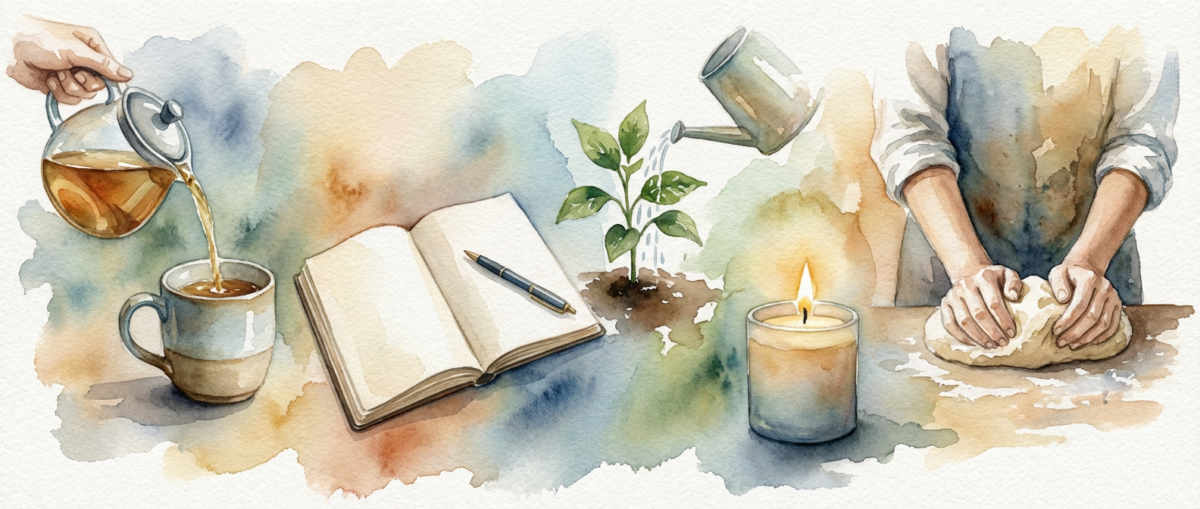
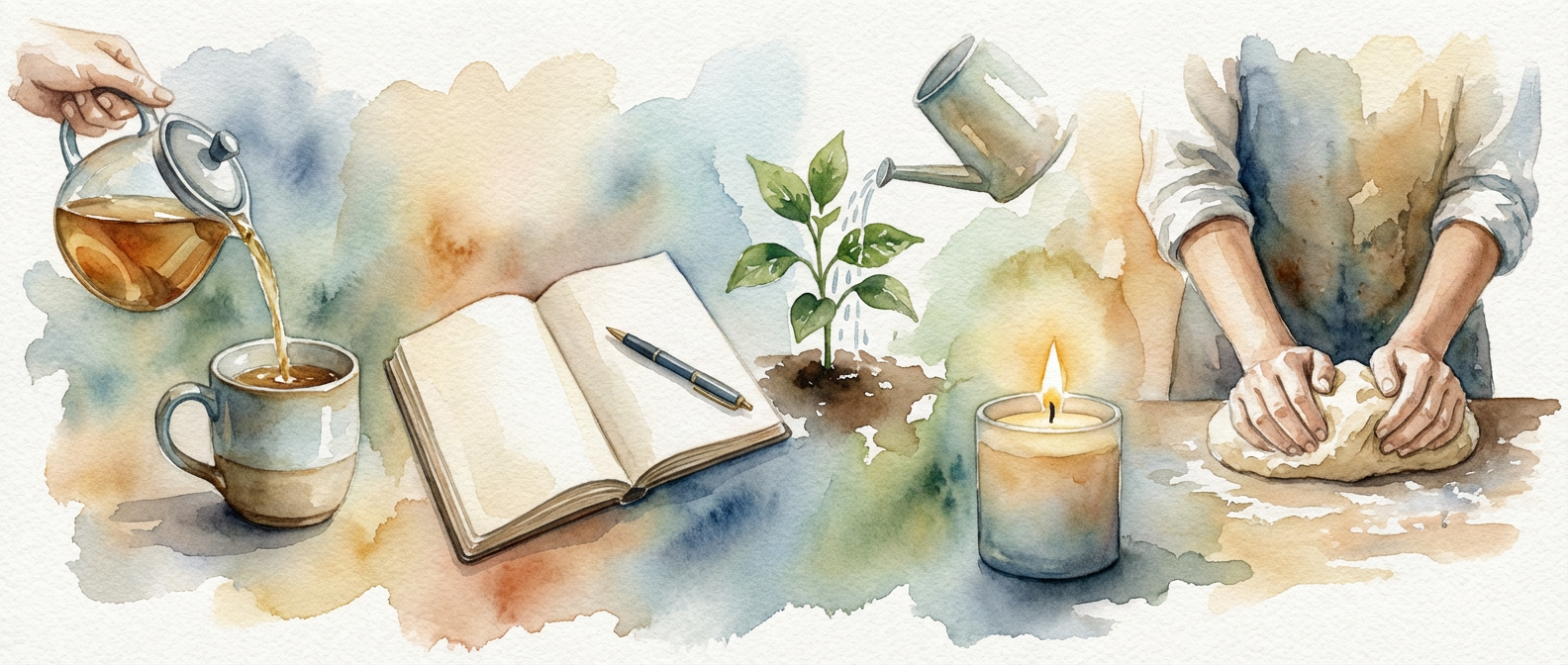
It started with a mug. Not just any mug, this specific blue ceramic one my sister brought me from a pottery studio in Vermont. I’d been drinking coffee out of whatever was clean, usually while scrolling my phone or rushing to get out the door. But one particularly overwhelming Tuesday morning, I made myself sit at my kitchen table with just the blue mug and my coffee. No phone, no laptop, no background podcast.

For exactly ten minutes, I sat there like an idiot. The silence felt aggressive. My brain kept trying to solve problems or remember tasks or worry about emails. But somewhere around minute seven, something shifted. The warmth of the mug in my hands, the steam rising up, the way the light hit the kitchen counter, it all felt suddenly present instead of like scenery I was rushing past.

I realized I hadn’t actually tasted my coffee in months. I’d been treating it like fuel instead of this small daily pleasure that was right there waiting for me. The ritual wasn’t about the coffee or the mug or even the sitting still. It was about remembering that I exist in my body, in this moment, in this specific place.

The Walk That Teaches Me How Days End

The evening walk happened by accident too. My neighbor’s dog, Charlie, had started barking every night around 6 PM, and instead of getting annoyed, I got curious. Turns out Charlie’s internal clock is more reliable than my phone’s calendar app. He knows when the day is transitioning to evening, and his bark was basically him saying, “Hey, pay attention to this shift.”

So I started walking around my neighborhood at 6 PM. Not for exercise or steps or any quantifiable benefit. Just to witness the day ending. The way porch lights start flickering on. How the sky changes color so gradually you don’t notice until suddenly it’s completely different. The sounds shifting from day noises to evening noises.

What surprised me was how much this small loop around four blocks became a bridge between work-brain and evening-brain. Without it, I’d find myself at 9 PM still mentally stuck in whatever problem I’d been wrestling with at 3 PM. The walk became this gentle way of telling my mind, “That part of the day is done now. You can set it down.”

I used to think transitions just happened automatically. Now I realize they need help, and a twenty-minute walk is apparently what does it for me.

The Sunday Reset That Actually Resets

Sunday evenings used to be the worst part of my week. That creeping dread of Monday morning, the weight of all the things I hadn’t done over the weekend, the general feeling that time was slipping away faster than I could grab onto it. I’d end up stress-cleaning my apartment or doom-scrolling until midnight, neither of which helped with the underlying anxiety.

Now I have what I generously call my Sunday practice, though it’s really just three specific things I do in order. First, I write down three things that went well during the week. Not major accomplishments or Instagram-worthy moments, just small things. Like how I had a really good conversation with the cashier at the grocery store, or figured out why my plant was looking droopy, or remembered to call my mom back within 24 hours instead of three days later.

Then I pick out what I’m wearing Monday morning and put it somewhere I can see it. This sounds ridiculous until you realize how much mental energy gets wasted on decision fatigue when you’re already running late and can’t find a clean shirt that matches your mood.

Finally, I make a list of three things I want to focus on the next week. Not a to-do list that will shame me by Thursday, just three areas where I want to put my attention. Sometimes it’s work stuff, sometimes it’s “remember to water the plants,” sometimes it’s “call the dentist I’ve been avoiding for six months.”

The whole thing takes maybe fifteen minutes, but it transforms Sunday night from this anxious void into something that feels intentional and calm.

What I Got Wrong About Grounding

I used to think being grounded meant being serious and centered and wise, like someone who meditates for an hour every morning and never feels rattled by anything. Turns out, for me at least, being grounded just means having a few reliable ways to remember where I am and what I’m doing here.

The blue mug reminds me that I have a body that can feel warmth and taste flavors. The evening walk reminds me that time moves in natural rhythms, not just in calendar notifications and deadline panic. The Sunday practice reminds me that weeks have shape and that I can participate in creating that shape instead of just being swept along by it.

None of these things require special equipment or apps or any particular spiritual framework. They’re just small ways of paying attention to what’s already happening. I was wrong about rituals being performative, they’re actually the opposite. They’re quiet, private ways of staying connected to the parts of life that matter but get drowned out by all the noise.

What are the small things that help you feel like yourself when everything else feels chaotic? I’m genuinely curious about the tiny rituals that work for other people, especially the ones that might seem completely unremarkable from the outside but create that sense of coming home to yourself.

Fall Is Actually the Worst Season and I’m Done Pretending Otherwise

The Great Autumn Lie We All Tell Ourselves

Here’s the thing nobody wants to admit about fall: it’s basically nature’s way of trolling us. We’ve all agreed to this collective delusion where dying leaves and rapidly shrinking daylight somehow equal peak cozy vibes. Meanwhile, I’m over here watching my neighbor post another Instagram story about “sweater weather” while she’s clearly shivering in that cardigan that’s doing absolutely nothing against the 45-degree wind.

Fall Is Actually the Worst Season and I'm Done Pretending Otherwise
Fall Is Actually the Worst Season and I’m Done Pretending Otherwise

Don’t get me wrong. I get the appeal on paper. Pumpkin spice everything, apple orchards, that one perfect day in October when the light hits just right and you think maybe this season isn’t so bad. But then you wake up the next morning and it’s somehow both humid and cold, your allergies are going insane from whatever’s rotting in the air, and you realize you’ve been gaslit by a season.

The worst part? We’ve turned this seasonal depression preview into a lifestyle brand. Fall has better marketing than most Fortune 500 companies, and we’re all buying what it’s selling.

Illustration for Fall Is Actually the Worst Season and I'm Done Pretending Otherwise
Illustration for Fall Is Actually the Worst Season and I’m Done Pretending Otherwise

The Temperature Betrayal

Fall weather is like that friend who says they’re “five minutes away” when they haven’t even left their house yet. It promises crisp, refreshing days and delivers the weather equivalent of a middle schooler who can’t decide what they want for lunch. Sixty degrees at 7 AM. Eighty by noon. Fifty by 4 PM. And somehow thirty-eight degrees when you’re walking to your car after dinner.

Yesterday I changed clothes three times. Not because I’m indecisive, but because the weather couldn’t commit to a personality for longer than four hours. I started with shorts, switched to jeans and a t-shirt, then found myself digging through boxes for my winter coat by evening. This isn’t seasonal transition. This is atmospheric bipolar disorder.

And the humidity situation? Summer humidity is straightforward misery you can plan for. Fall humidity is sneaky. It lurks in that sweater you thought would be perfect, turning what should be a cozy layer into a personal sauna. You’re simultaneously too hot and too cold, which I’m pretty sure violates several laws of physics.

The Daylight Robbery

Let’s talk about the elephant in the room: the sun starts ghosting us in September and doesn’t return our calls until March. By November, it’s dark when I leave for work and dark when I get home. I’m living in some discount vampire movie where all the dramatic tension got edited out.

People keep telling me to “embrace the hygge” or whatever, but there’s nothing cozy about feeling like you’re living in a cave for five months. That golden hour everyone raves about? It lasts approximately seventeen minutes and happens right when you’re stuck in traffic or sitting in a windowless meeting room discussing quarterly projections.

The real kicker is how this gradual light theft messes with your internal clock. Spring forward, fall back, whatever. By mid-October, my circadian rhythms are more confused than a GPS in a parking garage. I’m tired at 3 PM and wide awake at midnight. This would be fine if I were a vampire, but I’m just a regular person trying to function in a world designed for people who don’t experience seasonal existential dread.

The Maintenance Nightmare

Here’s what the fall aesthetic Instagram posts don’t show you: the sheer amount of work this season demands. Those gorgeous falling leaves? They don’t fall into neat piles that look like a Pottery Barn catalog. They fall everywhere, constantly, like nature’s version of glitter. Except glitter doesn’t get soggy and turn into slip hazards on your walkway.

I spent last weekend raking leaves for three hours. Three hours. Know what I accomplished? I moved leaves from my yard to bags, which I then had to haul to the curb, where they’ll sit until the city gets around to collecting them sometime before Christmas. Maybe. Meanwhile, the trees looked at my hard work and said, “Hold my beer,” and dropped another full layer overnight.

That’s just the leaves. Don’t forget about winterizing everything you forgot to winterize last year. Garden hoses, outdoor furniture, whatever’s left of your will to live after you realize you need to clean your gutters again. Fall isn’t a season. It’s an unpaid part-time job in property maintenance.

The Real Truth About Seasonal Beauty

Look, I’m not completely heartless. When fall decides to show up properly, with actual crisp air and trees that look like they’re on fire in the best possible way, it’s legitimately gorgeous. Those moments when you walk outside and the world looks like someone cranked up the saturation settings on reality? Pure magic.

But here’s my controversial take: those moments are rare enough that they don’t justify the other 85% of fall that ranges from “meh” to “why did I choose to live in a place with seasons?” We’ve convinced ourselves that a few Instagram-worthy afternoons make up for months of weather that can’t decide what it wants to be when it grows up.

Maybe the real problem isn’t fall itself, but our expectation that we should love every season equally. Winter makes no promises about being pleasant. Summer owns its intensity. Spring is honest about being a hot mess of allergies and unpredictable weather. But fall? Fall shows up with this whole cozy, romantic agenda that it can’t deliver on.

So there it is. My unpopular opinion laid bare. Fall is oversold and under-delivered, like a subscription box for seasonal depression. Am I wrong? Probably. Will I change my mind when I see the first really gorgeous fall day? Absolutely. Will I remember this rant when that happens? Not a chance.

What’s your most unpopular seasonal take? Are you team fall-is-perfect, or do you have your own weather-related grievances that polite society won’t let you voice?

Five Books That Rewired My Brain (And Why You Should Let Them Rewire Yours)

I used to think book recommendations were like giving someone your favorite sweater. What fits me perfectly might hang weird on you, and then we’re both disappointed. But some books don’t just fit—they alter the shape of how you see things. These five didn’t just entertain me or teach me facts. They changed the operating system.

The One That Made Me Question Everything I Thought I Knew About Thinking

Thinking, Fast and Slow by Daniel Kahneman destroyed my confidence in my own judgment in the best possible way. Before reading it, I thought I was reasonably rational. I made lists. I weighed pros and cons. I considered myself immune to obvious biases.

Kahneman’s book is like having a neuroscientist follow you around pointing out every mental shortcut you take. The availability heuristic explains why I always think plane crashes are more common after seeing news coverage. The confirmation bias reveals why I cherry-pick evidence that supports what I already believe. The anchoring effect shows how the first number I hear influences every estimate that follows.

This book hits hardest if you’ve ever been certain you were right about something, then discovered you were spectacularly wrong. So basically, everyone. Fair warning: you’ll start second-guessing yourself more, but you’ll also make better decisions. It’s an uncomfortable trade worth making.

The One That Changed How I See Other People’s Stories

Chimamanda Ngozi Adichie’s Americanah taught me about the weight of single stories. Not through lecture, but through Ifemelu’s experience of being Nigerian in America, then American-Nigerian back in Nigeria. The book shows how identity shifts depending on where you stand and who’s looking.

There’s a scene where Ifemelu realizes that in America, she’s become “African American” in ways that feel foreign to her actual experience. She starts a blog about race that’s funny and cutting and true. Reading her observations about American racial dynamics from an outsider’s perspective made me see my own country differently.

If you’ve ever felt like you didn’t quite fit the categories people put you in, this book will rearrange your mental furniture. Or if you’ve caught yourself making assumptions about someone’s background based on limited information. Adichie writes with the kind of specificity that makes universal truths feel personal.

The One That Revolutionized My Relationship With Failure

The Structure of Scientific Revolutions by Thomas Kuhn sounds like homework, and honestly, parts of it feel like homework. But buried in Kuhn’s analysis of how scientific knowledge advances is a revelation about how all progress actually works.

Kuhn argues that science doesn’t move forward through steady accumulation of facts. Instead, it lurches through paradigm shifts, moments when the old framework breaks down and gets replaced entirely. Normal science is puzzle-solving within accepted rules. Revolutionary science throws out the rulebook.

This reframed every failure I’d experienced. Maybe the problem wasn’t that I was bad at something. Maybe I was working within the wrong paradigm entirely. It gave me permission to question fundamental assumptions instead of just trying harder within systems that weren’t working. This perspective shift applies to everything from career pivots to relationship problems to creative blocks.

The One That Made Me Understand Power Differently

Robert Caro’s The Power Broker is 1,200 pages about Robert Moses, the man who shaped modern New York through highways, bridges, and parks. It sounds niche, but it’s actually about how power accumulates and operates in ways most people never see.

Moses never held elected office, but he controlled more government resources than most governors. He understood that control over bureaucracy beats electoral popularity. He built his influence through mastering bond financing, legal technicalities, and institutional relationships. He made himself indispensable, then used that position to reshape an entire region according to his vision.

The book changed how I see organizational dynamics everywhere. Power isn’t always where the org chart says it is. The person who controls information flow, or understands the budget process, or maintains key relationships often wields more influence than people with fancier titles. If you’ve ever wondered why certain decisions get made or why change is so hard to implement, Caro’s forensic examination of Moses is a masterclass in how systems really work.

The One That Changed How I Think About Stories Themselves

John McPhee’s Oranges is exactly what it sounds like: a book about oranges. How they grow, how they’re processed, how they’re marketed, how they’ve shaped California agriculture. In most hands, this would be incredibly boring.

But McPhee finds drama in concentration techniques and poetry in supply chains. He shows how paying close attention to any subject reveals layers of complexity and human stories you never expected. There’s tension in the question of whether orange juice should be made from concentrate. There’s character development in his profiles of citrus farmers.

This book taught me that interesting writing isn’t about interesting subjects, it’s about interesting attention. McPhee’s approach works whether he’s writing about oranges, geology, or canoe trips. If you’ve ever thought your work or interests were too mundane to be worth exploring deeply, McPhee will cure you of that notion. He proves that everything is fascinating if you look closely enough and think clearly about what you’re seeing.

These books didn’t just give me information. They gave me new ways of processing information. They’re tools for thinking differently, and tools get better with use. What books have changed the shape of your thinking? I’m always collecting recommendations for the next mental renovation project.

The Tech That Actually Made My Life Better (And Might Make Yours Better Too)

The App That Remembers So I Don’t Have To

You know that thing where you’re standing in the grocery store, staring at the pasta sauce aisle, wondering if you already have marinara at home? I used to take photos of my pantry before shopping trips. Real sophisticated stuff. Then I found Pantry Check, and suddenly I became the person who actually knows what’s in their kitchen.

The Tech That Actually Made My Life Better (And Might Make Yours Better Too)

This isn’t some fancy meal planning app that wants to reorganize your entire life. It’s just a simple inventory system where you scan barcodes as you use things up. Takes maybe three seconds per item. The magic happens when you’re shopping and can actually search “tomato” and see that yes, you have two cans of diced tomatoes but you’re out of paste.

Perfect for anyone who’s ever bought duplicate condiments or stood in Target wondering if you need more dish soap. Also great if you’re the type who stocks up during sales but then forgets what you stockpiled. The app has saved me from both waste and those weird dinner nights where I’m trying to make something happen with random pantry ingredients.

Illustration for The Tech That Actually Made My Life Better (And Might Make Yours Better Too)

The Device That Solved My Sleep Without Being Weird About It

I’ve tried sleep tracking apps that want me to put my phone under my pillow like some kind of millennial dream catcher. Hard pass. The Oura Ring sits on your finger and figures out your sleep patterns without requiring you to change anything about how you actually sleep.

What makes this different from other sleep tech is that it doesn’t lecture you. It just shows you data. Your deep sleep percentage, how much you moved around, when your body temperature shifted. After a few weeks, you start noticing patterns. Like how that second cup of coffee at 3 PM consistently messes with your sleep quality, or how you sleep better on days when you go for walks.

The insights are specific enough to be useful but not so detailed that you need a PhD to understand them. It’s for people who want to sleep better but don’t want to turn their bedroom into a laboratory. The battery lasts about a week, and it’s waterproof, so you can actually forget you’re wearing it. Which is exactly how sleep tracking should work.

The Browser Extension That Guards Your Future Self

StayFocusd is like having a really patient friend who gently reminds you that you said you wanted to be productive today. It limits how much time you can spend on specific websites, but here’s the clever part: you set the restrictions when you’re feeling motivated, and then it enforces them when you’re feeling… less motivated.

You can customize it completely. Maybe you want to allow yourself 20 minutes of social media during work hours, or maybe you need to block news sites after 8 PM because doom-scrolling before bed never helped anyone sleep better. The extension tracks your usage and shows you exactly where your time goes, which is both enlightening and slightly horrifying.

This is perfect for anyone who has good intentions about their internet habits but struggles with follow-through. It’s not about completely eliminating fun websites, just about being intentional with them. The nuclear option lets you set restrictions that are nearly impossible to disable, which sounds extreme but is actually brilliant for those moments when future you needs saving from present you.

The Old-School Solution That Still Works Better Than Everything New

While everyone’s trying to reinvent note-taking with AI and cloud sync and collaborative features, I’ve been using Simplenote for years. It does exactly one thing: syncs plain text notes across all your devices instantly. No formatting options to distract you, no subscription tiers, no features you don’t need.

The search function actually works, which seems like a low bar but you’d be surprised how many apps mess this up. You can tag notes, share them, and even publish them as web pages if you want. But mostly it just stays out of your way and lets you write things down quickly.

This is for people who want their notes to be available everywhere without thinking about it. Writers who need a place to capture random thoughts. Anyone who’s ever lost something important because they wrote it in a fancy app that decided to reorganize their filing system. Sometimes the best technology is the technology that just works and doesn’t try to be clever about it.

I’m always curious about what tools actually make a difference in people’s daily routines versus the ones that just sound good in theory. Have you found any tech that genuinely improved your life without adding complexity? The kind of stuff that just quietly works in the background, making things a little bit easier? I’d love to hear what’s actually worth the download in your experience.