Personal essays, notes, and ideas worth sharing.

Author: Lonnie Fields (page 25 of 26)

The Messy Middle of Making Meaning: What a Year of Journaling Actually Taught Me

The Stationery Store Epiphany

I was standing in the pen aisle of Target, holding a $24 dotted notebook, when it hit me. This wasn’t about organization. The bullet journaling craze that’s generated a $200 million market in specialized planners and premium pens isn’t really about productivity at all. It’s about something much more fundamental: the human need to make sense of our days.

Three notebooks later, I can tell you that journaling is messier than Instagram makes it look. There’s no perfect system. No life-changing revelation on page 47. Just the slow, sometimes boring work of paying attention to what actually happens when you’re not performing your life for an audience.

What the Research Gets Right (and What It Misses)

The science backs up what journal evangelists have been saying for years. Studies show consistent journaling reduces cortisol levels and improves working memory. The strongest evidence in positive psychology research points to gratitude journaling specifically. Write down three things you’re grateful for each day, and measurable changes appear in brain scans within weeks.

But here’s what the research doesn’t capture: the weird stuff that happens between the lines. Like how writing about a frustrating conversation reveals patterns you’ve been blind to for months. Or how documenting small wins makes you notice there were more of them than you thought. The real benefits aren’t just stress reduction. They’re pattern recognition.

Social media has noticed, of course. Therapy-adjacent journaling prompts rack up millions of views on TikTok, promising emotional breakthrough in 60-second clips. But sustainable self-reflection doesn’t happen in viral moments. It happens in the unglamorous middle, when you’re writing about Tuesday again and wondering if any of this matters.

The Long Game of Meaning-Making

Somewhere between bullet points and brain dumps, I started to understand what James Clear habit building approaches get at: consistency beats intensity. The journal entries that changed how I see myself weren’t the dramatic breakthrough moments. They were the accumulated weight of small observations, building into something I couldn’t see while I was writing them.

This mirrors what’s happening in the broader writing world. People are walking away from the performance of social media and returning to longer-form personal reflection. Substack and Ghost are seeing unprecedented growth in personal essay writing. Readers are hungry for authentic, unfiltered thinking. The kind that takes time to develop and can’t be squeezed into a caption.

Something is happening here that feels like reclamation. We’re taking back our own narratives from algorithms that prioritize engagement over truth. The Marginalian long-form writing shows this perfectly: deep, thoughtful pieces that resist the pressure to reach a tidy conclusion. Sometimes the most honest thing you can say is “I’m still figuring this out.”

What Nobody Tells You About Self-Reflection

The hardest part of keeping a journal isn’t remembering to write. It’s resisting the urge to edit your experience in real-time. To make your feelings more palatable, your reactions more reasonable, your growth more linear than it actually is.

I’ve written the same complaint about work seventeen times this year. The same anxiety about relationships in slightly different words. The same excitement about projects that fizzled by the next entry. At first, this felt like failure. Wasn’t self-reflection supposed to move me forward faster?

But repetition is data too. Seeing the same themes surface again and again forces you to take them seriously. That work complaint isn’t just bad day venting anymore, it’s pointing to something structural that needs attention. The relationship anxiety isn’t overthinking, it’s information about what you actually need from people.

The False Promise of Resolution

Here’s what I learned this year that nobody wants to hear: meaningful self-reflection doesn’t lead to tidy conclusions. It leads to better questions. More nuanced understanding. An increased tolerance for contradiction and uncertainty.

The year-end retrospective industrial complex wants us to package our experiences into lessons learned and goals for next year. But real growth is messier than that. It’s holding multiple truths at once. Knowing that you’re both more resilient and more fragile than you thought. That you’ve made progress and keep making the same mistakes. That clarity and confusion can coexist in the same week, sometimes the same hour.

Maybe that’s the real value of sustained journaling: not arriving at answers, but becoming more comfortable with questions. Learning to sit with complexity instead of rushing toward resolution. Developing what therapists call distress tolerance, but for the everyday experience of being human in an uncertain world.

If you’ve been thinking about starting a journaling practice, or returning to one you’ve abandoned, know this: there’s no perfect system waiting to be discovered. Just the ongoing work of paying attention to your own life. It’s less glamorous than the productivity gurus suggest and more valuable than you might expect. What patterns might emerge if you simply started noticing what actually happens in your days?
The Messy Truth About Writing Your Way Through Another Year

The Awkward Honesty of Looking Back

December arrives with its predictable parade of year-end reflection prompts. The internet fills with templates for gratitude lists and goal-setting worksheets. Everyone wants to package twelve months into neat categories of wins and losses, lessons learned and resolutions made.

The Messy Truth About Writing Your Way Through Another Year

But here’s what actually happens when you sit down to review your year through writing. The story refuses to behave. The narrative resists your attempts to make it clean. What emerges instead is something messier and more honest than any Instagram-worthy reflection post.

This resistance isn’t a bug in the system. It’s what makes journaling and self-reflection so unexpectedly powerful. Research consistently shows that regular journaling reduces cortisol levels and strengthens working memory. But these clinical benefits barely scratch the surface of what happens when you commit to writing through the complexity of being human.

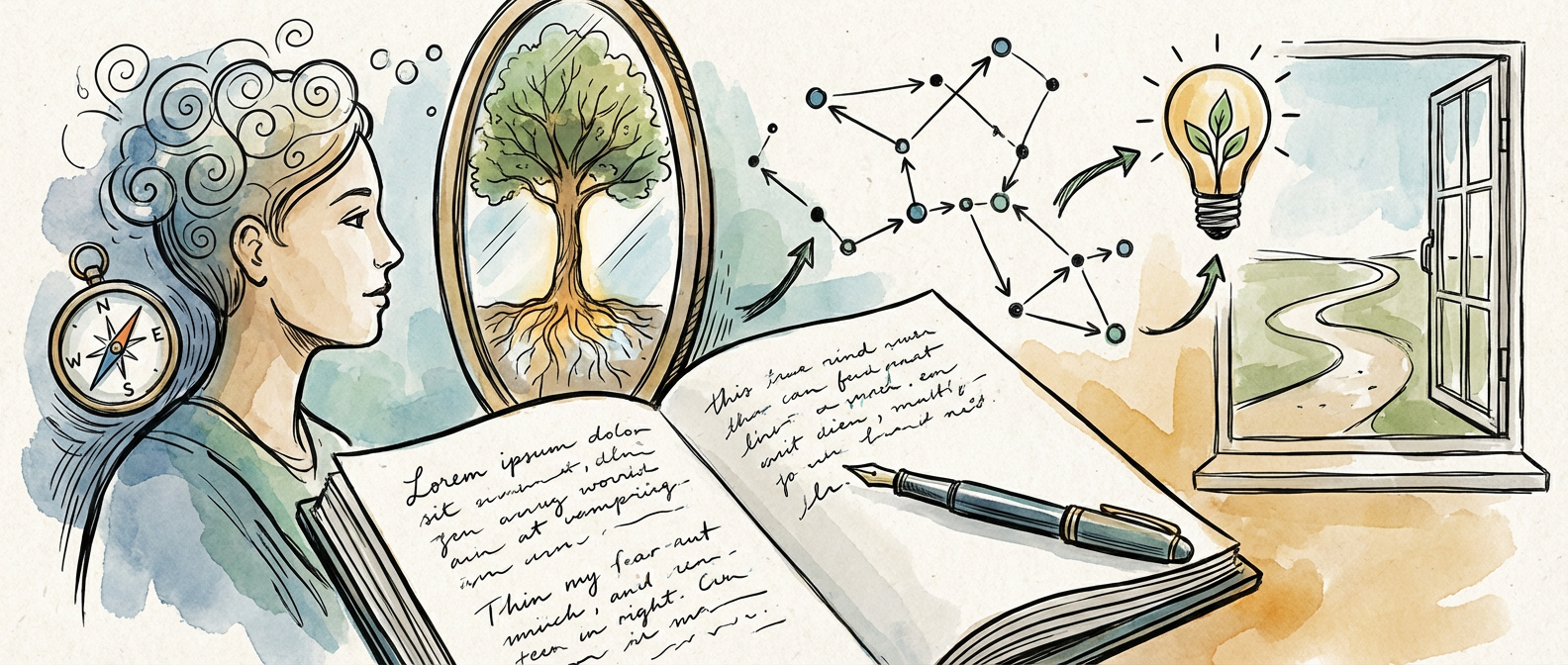
Illustration for The Messy Truth About Writing Your Way Through Another Year

When Digital Noise Meets Analog Quiet

The irony of our current moment is striking. While therapy-adjacent journaling prompts rack up millions of views on TikTok, people are simultaneously fleeing the noise of social media for quieter forms of expression. The bullet journaling movement has created a $200 million market in planners and stationery. Personal blogs are experiencing a renaissance as writers reclaim their narratives from algorithmic feeds.

This isn’t nostalgia for simpler times. It’s recognition that some forms of thinking require space that social media simply can’t provide. The pause between question and answer. The ability to contradict yourself on the page without immediate judgment. The freedom to be boring, repetitive, or unclear while you work through an idea.

Long-form personal essays are finding eager audiences on platforms like Substack and Ghost. Readers hungry for depth gravitate toward writers who resist the pressure to perform wisdom they haven’t actually earned. They want to witness the process of sense-making in real time, complete with false starts and dead ends.

Beyond Gratitude Lists

Gratitude journaling has the strongest evidence base of all positive psychology interventions when studied in randomized controlled trials. But the practice itself often gets reduced to a superficial exercise in toxic positivity. Write down three things you’re grateful for each day, and watch your life transform.

Real gratitude work is more complicated. It means sitting with the discomfort of appreciating something while also acknowledging its limitations. Being grateful for a relationship that also frustrates you. Appreciating a job that pays your bills but doesn’t fulfill your deepest ambitions. Recognizing the privilege built into your problems.

The most meaningful year-end reflections emerge when you resist the urge to tie everything up with neat conclusions. Instead of asking “What did I learn?” try “What am I still confused about?” Instead of “How did I grow?” consider “Where did I stay exactly the same even when I tried to change?”

How We Build Meaning from Chaos

Meaning doesn’t arrive pre-packaged. It gets constructed through the act of attention, through the choice to notice patterns and connections that might otherwise remain invisible. This is where the real work of journaling happens, in the space between experience and understanding.

Writing forces you to slow down enough to notice contradictions. The way you can feel grateful for your health while frustrated by your body’s limitations. How a year that felt mostly disappointing somehow contained moments of unexpected beauty. The recognition that growth often looks like moving in circles rather than straight lines.

Some of the most compelling contemporary writing happens at this intersection of personal experience and broader meaning-making. Writers like those in The Marginalian long-form writing demonstrate how individual reflection can illuminate universal truths without sacrificing specificity or complexity.

The Practice of Unfinished Thinking

Perhaps the most valuable aspect of reflective writing is its tolerance for incompleteness. Unlike conversation, which demands real-time responses, writing allows you to sit with uncertainty. You can explore an idea without having to defend it. Change your mind mid-sentence. Discover what you think by watching what you write.

This is particularly important when reviewing a year that defied your expectations. The job that didn’t materialize. The relationship that ended differently than you hoped. The goals that shifted or dissolved entirely. These experiences resist simple categorization as either success or failure.

The habit-forming wisdom popularized by resources like James Clear habit building emphasizes the power of small, consistent actions over dramatic transformations. The same principle applies to reflective writing. Regular engagement with your own thoughts and experiences builds capacity for self-understanding that can’t be rushed or forced.

Your year probably doesn’t fit neatly into any template for growth or achievement. The story is still unfolding, still revealing its contours and contradictions. That’s not a problem to be solved but a reality to be explored, one page at a time.

The Messy Art of Making Sense: Why Your Journal Doesn’t Need to Be Perfect

The Science of Scribbling

Your brain on journaling looks different. Literally. Studies show that regular writing reduces cortisol levels and sharpens working memory. When you put pen to paper, you’re not just recording thoughts. You’re rewiring neural pathways.

The Messy Art of Making Sense: Why Your Journal Doesn't Need to Be Perfect
The Messy Art of Making Sense: Why Your Journal Doesn’t Need to Be Perfect

But here’s what the research doesn’t capture: the messy middle. The false starts. The days when your profound insights sound like grocery lists. I’ve been keeping what I call a “process notebook” for three years now, and most entries would embarrass my high school English teacher. That’s exactly the point.

We’re not trying to write perfect prose here. We’re building a thinking practice. The $200 million bullet journal market proves people want structure, but the real magic happens in the margins where your brain wanders off-script.

Beyond Gratitude Lists

Gratitude journaling gets the strongest research backing of all positive psychology interventions. The randomized controlled trials are convincing. Write down three things you’re thankful for, and your wellbeing measurably improves.

But gratitude lists can feel hollow when life gets complex. That’s where meaning-making comes in. Instead of cataloging blessings, try tracking questions. What confused you today? What assumption got challenged? What small thing made you pause?

I started noting moments when my autopilot got disrupted. A stranger’s comment that stuck. A news headline that didn’t fit my worldview. These interruptions become raw material for understanding how I make sense of things. The therapy-adjacent prompts flooding TikTok tap into this hunger for deeper self-examination, generating millions of views because people are desperate to understand their own minds.

Reclaiming Your Own Story

Social media turned us all into performers in our own lives. Every experience became content. Every thought got flattened into shareable chunks. No wonder there’s a personal blog renaissance happening as people reclaim their narratives from algorithmic feeds.

Long-form personal essays are finding audiences again on platforms like Substack and Ghost. Writers like those featured in The Marginalian long-form writing remind us that complexity deserves space. Your inner life doesn’t need to fit in a tweet.

A process notebook gives you permission to think in paragraphs instead of soundbites. To contradict yourself across entries. To change your mind publicly, even if your only audience is future you.

Building the Habit Without the Pressure

The habit formation crowd will tell you to journal every day at the same time. James Clear habit building wisdom suggests starting small and staying consistent. There’s value in that approach.

But meaning-making doesn’t follow a schedule. Sometimes clarity comes at 2 AM after a difficult conversation. Sometimes insight hits during your commute. I keep my process notebook flexible. Write when there’s something to process, not because the calendar says so.

The goal isn’t perfect consistency. It’s creating a container for your evolving understanding of yourself and the world. Some weeks I write daily. Others, I barely touch the notebook. The practice adapts to life’s rhythms instead of forcing life to adapt to the practice.

The Unfinished Project of Selfhood

Here’s what three years of process journaling taught me: you’re not a fixed entity waiting to be discovered. You’re an ongoing project, constantly under construction. Each entry is a small experiment in understanding.

My early notebooks were full of confident pronouncements about who I was and what I believed. Recent entries are more tentative, more curious. I’ve learned to write “I think” and “maybe” more often. Uncertainty became more interesting than certainty.

The real value isn’t in having profound thoughts. It’s in developing a relationship with your own thinking. In catching yourself in the act of making meaning. In building tolerance for not knowing while you figure it out.

What would you discover about your own mind if you gave it space to wander on paper? Start messy. Start small. Start today. Your future self will thank you for the breadcrumbs you leave behind.

The Life-Changing Magic of Writing to Yourself (And Why Everyone’s Finally Doing It)

Why Your Future Self Will Thank You for Starting Today

You know that friend who swears by their morning pages? The one who pulls out a worn notebook at coffee shops and actually writes in it? They’re onto something bigger than you think. Journaling isn’t just trendy self-care anymore. It’s become a genuine antidote to our fractured digital lives.

Research backs up what journalers have known intuitively for centuries. Studies show that regular writing reduces stress hormones like cortisol while boosting working memory. Your brain literally works better when you give it space to process on paper. Think of journaling as strength training for your mind.

But here’s what makes this moment different. We’re living through a personal writing renaissance. While social media breaks our thoughts into bite-sized performances, people are rediscovering the power of writing for an audience of one. Long-form personal essays are finding hungry readers on platforms like Substack and Ghost. Writers like those featured on The Marginalian long-form writing prove that deep, reflective writing still moves people.

The Billion-Dollar Proof That Paper Still Matters

The numbers tell a story. Bullet journaling alone has created a $200 million market in specialized notebooks and planning supplies. That’s real money chasing real human need. People aren’t just buying pretty journals. They’re investing in a practice that helps them think clearly.

Meanwhile, therapy-inspired journaling prompts rack up millions of views on TikTok. Young people especially are turning to structured self-reflection as mental health support becomes more expensive and harder to access. These aren’t just trending hashtags. They’re lifelines.

Of all positive psychology interventions studied, gratitude journaling shows the strongest evidence in randomized controlled trials. Writing down what you’re grateful for isn’t just feel-good fluff. It’s scientifically validated mood improvement that costs nothing but time.

Who This Actually Works For (And Who Should Skip It)

Journaling works best for people who think by processing. If you’re someone who talks through problems or needs to verbalize thoughts to understand them, writing might feel frustratingly slow at first. Give it three weeks anyway. Many verbal processors discover that writing opens up different thinking patterns.

It’s perfect for overthinkers who get caught in mental loops. When your thoughts spin, writing breaks the cycle. It forces linear thinking and creates distance from emotional intensity. You’re not just feeling your feelings anymore. You’re observing them.

Skip journaling if you’re looking for instant gratification or quick fixes. This is slow medicine. Benefits build over months, not minutes. If you need immediate mood boosts, try movement or music first. Come back to journaling when you’re ready for long-term emotional fitness.

It also works brilliantly for goal-oriented people who want to track patterns and progress. James Clear habit building principles apply perfectly here. Small, consistent writing sessions build into powerful self-awareness over time.

Three Approaches That Actually Stick

Start with morning brain dumps. Set a timer for ten minutes and write whatever comes to mind. Don’t edit or structure. Just empty your mental cache onto paper. This clears psychological bandwidth for the day ahead and catches recurring worries before they multiply.

Try evening reflection with three simple questions: What went well today? What challenged me? What did I learn? This isn’t about profound insights. It’s about building the habit of noticing. Awareness comes before change.

Experiment with prompt-based journaling when you need direction. Questions like “What would I do if I weren’t afraid?” or “What patterns am I noticing in my relationships?” give structure to your exploration. Prompts work especially well when life feels stagnant or confusing.

Making Meaning in the Mess

The real magic happens when you read old entries. Patterns emerge that you couldn’t see while living through them. Problems that seemed impossible reveal themselves as stepping stones. You start seeing your life as a story with themes and growth arcs instead of random events happening to you.

This is where journaling goes beyond mere habit tracking or emotional venting. It becomes meaning-making. You’re not just recording what happened. You’re discovering what it means and who you’re becoming through it all.

In our algorithm-driven world, journaling returns control of your narrative to you. Social media platforms decide what’s worth remembering through their feeds. Your journal holds space for the quiet moments that actually matter. The small victories. The gradual shifts. The questions that lead somewhere important.

Ready to reclaim your inner conversation? Start small, stay curious, and trust the process. Your thoughts are worth exploring, and your story deserves someone who’s genuinely interested in hearing it. That someone is you.

Journaling, self-reflection and meaning-making: Honest opinion

Here is the thing I keep coming back to on this. The topic of journaling, self-reflection and meaning-making rewards more careful attention than the typical coverage provides, and the reason is not complicated once you know where to look.

What I find most interesting, and I think you will too, viewed through the lens of honest opinion, is bullet journaling spawning a $200 million market in stationery and planners. The willing to be wrong read of the situation is also the more accurate one once you examine what the evidence actually shows.

The Opinion: Setting the Terms

Journaling shown to reduce cortisol and improve working memory in studies is not just a data point in the story of journaling, self-reflection and meaning-making. It’s the structural condition that makes everything else in this analysis legible. Context like this doesn’t age quickly. The conditions that produced it have been building for years, and the convergence is what makes the current moment distinct from previous moments that looked similar from a distance.

Bullet journaling spawned a $200 million market in stationery and planners.

Therapy-adjacent journaling prompts generate millions of views on TikTok. The Marginalian long-form writing has been tracking this dimension consistently.

What makes this moment worth examining carefully is not the novelty but the confirmation. The underlying dynamics have been visible for some time. What’s new is that they have reached a threshold where ignoring them requires active effort rather than simple inattention. That threshold crossing is the event, not the underlying movement that produced it.

And gratitude journaling has the strongest RCT evidence of all positive psychology interventions. It’s part of that same picture. These elements don’t exist in separate silos. They’re reinforcing conditions in the same structural shift.

The Unpopular Opinion: The Analysis

Gratitude journaling’s RCT evidence being strongest of all positive psychology interventions is where the analysis gets more specific. The surface reading is accessible and not wrong, but it misses the mechanism. The mechanism is where the practical insight lives. What I find most interesting, and I think you will too, is that the mechanism is a personal blog renaissance growing as people reclaim narrative from social media. Understanding it changes what you do with the information.

Long-form personal essays are finding audiences on Substack and Ghost.

The skeptical counterargument deserves honest engagement: prior moments with similar surface characteristics did not produce the outcomes that seemed logical at the time. That history is real. What’s different now is long-form personal essays finding audiences on Substack and Ghost. This isn’t a minor variable. It’s the infrastructure condition that previous cycles lacked. Infrastructure changes tend to persist in ways that sentiment-driven changes don’t. James Clear habit building is one source tracking this dimension with the rigour it requires.

There’s also a distributional question that often goes unaddressed in coverage of journaling, self-reflection and meaning-making: who captures the value created by these shifts, and who absorbs the disruption costs? The aggregate picture can be positive while the distribution is uneven in ways that matter enormously to specific participants. Keeping that distributional lens in view is part of reading the situation clearly rather than simply optimistically.

Implications: What This Means If You Care About Productivity culture critiques

The implications of journaling, self-reflection and meaning-making extend beyond the immediate context. Journaling shown to reduce cortisol and improve working memory in studies combined with the structural conditions described above creates a situation where adjacent fields, decisions, and communities are affected in ways that aren’t always visible from inside the primary story. The second-order effects are frequently more important than the first-order ones. They’re where careful attention pays the highest returns.

Distinct individual voice. Whatever that person actually sounds like.

The practical question isn’t whether to engage with these dynamics but how. The answer depends on context. On what role you occupy relative to journaling, self-reflection and meaning-making and what your actual decision horizon is. But the first step is the same regardless: accurate understanding of what’s actually happening rather than what the most available narrative says is happening.

A few concrete observations are worth separating out from the broader analysis. First: bullet journaling spawning a $200 million market in stationery and planners isn’t a temporary condition. It’s a new baseline. Second: personal blog renaissance growing as people reclaim narrative from social media suggests that the adjustment period isn’t over. Third, and most important: the organizations and individuals who are treating the current moment as a new steady state rather than a transition are making a categorization error that will be costly to unwind later.

The Case Against: What the Critics Get Right

Intellectual honesty requires acknowledging the strongest counterarguments, not just the weakest ones. The case against the optimistic reading of journaling, self-reflection and meaning-making isn’t trivial. There are structural vulnerabilities in the current picture that deserve direct engagement rather than dismissal.

The most serious objection is the one about sustainability. Therapy-adjacent journaling prompts generating millions of views on TikTok can be read not as a foundation but as a ceiling. A point beyond which growth becomes self-limiting because of the very dynamics that produced it. If the current state has already incorporated most of the available supply of early-adopting participants, the remaining growth curve may be structurally shallower than the recent trajectory implies.

Long-form personal essays are finding audiences on Substack and Ghost.

Looking Forward

The trajectory here is clearer than the pace. Making predictions about when specific thresholds will be crossed is genuinely difficult, and anyone claiming precision about timelines should be treated with skepticism. But the direction, toward journaling shown to reduce cortisol and improve working memory and continued development of the conditions described above, is supported by the evidence in a way that isn’t contingent on a single variable going right.

Long-form personal essays finding audiences on Substack and Ghost is the variable to watch as the leading indicator. Historical patterns suggest it moves first, with broader metrics following with some lag. This doesn’t make the outcome certain, but it makes it legible. And legibility is the precondition for good decisions.

Three questions are worth holding as the story develops. First: are the structural conditions that enabled the current state durable, or are they cyclical? Second: who is positioned to benefit from the next phase, and does that differ materially from who benefited in the current phase? Third: what would a clean falsification of the optimistic thesis look like, and is there any evidence of that signal emerging? These questions don’t need answers today. But having asked them changes what you notice in the months ahead.

That’s my read. I want to hear yours.

Make the case against this. I genuinely want to hear it.